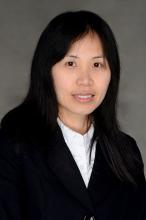
Lixuan Lu
PhD
Professor
Faculty of Engineering and Applied ScienceDr. Lu’s research focus includes probabilistic safety assessment and artificial intelligence.
Languages
English, Chinese
lixuan.lu@ontariotechu.ca
905.721.8668 ext. 5526
- PhD in Electrical and Computer Engineering University of Western Ontario, London, Ontario 2005
- MES in Automatic Control Beijing Institute of Technology, China 2001
- BES in Automatic Control Beijing Institute of Technology, China 1998
- W. Al-Dabbagh and L. Lu, Dynamic Flowgraph Modeling of Process and Control Systems of a Nuclear-based Hydrogen Production Plant, International Journal of Hydrogen Energy, 35, pp 9569-9580, 2010
- W. Al-Dabbagh and L. Lu, Reliability Modeling of Networked Control Systems Using Dynamic Flowgraph Methodology, Reliability Engineering and System Safety, 95, pp 1202-1209, 2010
- N. Khan and L.Lu, Decentralized State-Space Controller Design of a Large PHWR, Nuclear Technology, vol. 172, pp 278-286, 2010
- W. Al-Dabbagh and L. Lu, Design and Reliability Prediction of the Control System for Nuclear-based Hydrogen Production with Copper-chlorine Thermochemical Cycle, International Journal of Hydrogen Energy, 35, pp 966-977, 2010
- L. Lu and J. Lei, Design and Reliability Prediction of a Distributed Landing Gear Control System, Aircraft Engineering and Aerospace Technology, Volume 82, Issue 1, pp 15-22, 2010
- W. Al-Dabbagh, L. Lu, A. Mazza, Modeling, Simulation and Control of a Proton Exchange Membrane Fuel Cell (PEMFC) Power System, International Journal of Hydrogen Energy, 35, pp 5061-5069, 2010
- G. F. Naterer S. Suppiah, M. Lewis, K. Gabriel, I. Dincer, M.A. Rosen, M. Fowler, G. Rizvi, E.B. Easton, B.M. Ikeda, M.H. Kaye, L. Lu, I. Pioro, P. Spekkens, P. Tremaine, J. Mostaghimi, J. Avsec, J. Jiang, Recent Canadian Advances in Nuclear-based Hydrogen Production and the Thermochemical Cu-Cl Cycle, International Journal of Hydrogen Energy, 34, pp 2901-2917, 2009
- G. F. Naterer, K. Gabriel, L. Lu, Z. Wang, Y. Zhang, Recent Advances in Nuclear-based Hydrogen Production with a Thermochemical Copper-Chlorine Cycle, Journal of Engineering for Gas Turbines and Power, Volume 131, 032905-1-032905-10, 2009
- L. Lu and G. Lewis, Configuration Determination for Standby k-out-of-n Systems, Reliability Engineering and System Safety, Volume 93, Issue 11, pp 1594-1604, 2008
- F. Ali and L. Lu, "A Method to Eliminate the Effect of Radiation on Thermocouple Performance", Nuclear Engineering and Design, Number 237, pp 1522-1525, 2007
- L. Lu and J. Jiang, The Unavailability, Spurious Operation and Cost Analysis for Standby K-out-of-N Systems, Reliability Engineering and System Safety, Volume 92, pp 144-155, 2007
- L. Lu and J. Jiang, Joint Failure Importance for Noncoherent Fault Trees, IEEE Transactions on Reliability, Volume 56, Number 3, pp 435-443, 2007
- P. McNelles and L. Lu, A Review of The Current State of FPGA Systems in Nuclear Instrumentation and Control, 21st International Conference on Nuclear Engineering, 2013
- H. Tang and L. Lu, Application of the Model Free Adaptive Control to the Heat Exchanger in a Nuclear Hydrogen Generation Plant, Proceeding of the ORF Hydrogen Production Workshop, 2013
- M. Bellicoso, R. Machrafi and L. Lu, Simulation Design of a Gas Filling Station for Geiger Mueller Detectors, International Conference on Advances in Industrial Control, Electronics and Computer Engineering, 2013
- Y. Tao and L. Lu, Risk-informed Maintenance for Non-coherent Systems, Reliability and Maintainability Symposium (RAMS), 2013
- A. Lee and L. Lu, Petri Net Modeling for Probabilistic Safety Assessment and Its Application in the Airlock System of a CANDU Nuclear Power Plant, Procedia Engineering, vol. 45, pp 11-20, 2012
- M.R. Razzaq and L. Lu, An Overview of Multi-carrier Modulation System for Data Transmission through Smart Grid, Proceedings of the IEEE Power Engineering and Automation Conference, pp 500-503, 2011
- F. Ahmed, L. Lu and G. Naterer, Development of a CANDU SCWR and Copper Chloride Hydrogen Co-generation Model, Proceedings of the 5th International Symposium on Supercritical-Water-Cooled Reactors, pp 141-149, 2011
- L. Lu, An Overview of Risk Importance Measures and Investigation on Their Applications for Maintenance, Proceedings of the International Symposium on Safety Science and Technology, Progress in Safety Science and Technology, vol. VIII, part A, pp 113-120, 2010
- L. Lu and D. Le, Design of an Ethernet Bus Interface Controller in a Nuclear Power Plant Simulator, Proceedings of the 18th International Conference on Nuclear Engineering, 2010
- Y. Tao and L. Lu, Risk Importance Measures for Maintenance in Non-coherent Systems, Proceedings of the 18th International Conference on Nuclear Engineering, 2010
- F. Ahmed, L. Lu and G. Naterer, Reactivity Control and Load Cycling of CANDU System, Proceedings of the 23rd IEEE Canadian Conference on Electrical and Computer Engineering, 2010 (CCECE 2010)
- L. Lu and L. Dong, Reliability Prediction of an Ethernet Bus Interface Controller in a Nuclear Power Plant Simulator, Proceedings of the IEEE International Conference on Industrial Engineering and Engineering Management, pp 832-836, 2009
- Y. Zhang, L. Lu, and G. F. Naterer, Reliability and Safety Assessment of a Conceptual Thermochemical Plant for Nuclear-based Hydrogen Generation, Proceedings of the 16th International Conference on Nuclear Engineering, 2008
- L. Lu and G. Lewis, Reliability Evaluation of Standby Safety Systems Due to Independent and Common Cause Failures, proceedings of the 2006 IEEE Conference on Automation Science and Engineering, pp 274-279, 2006
- Digital Systems (ELEE 2450U)
Boolean algebra and truth tables; combinational logics: AND, OR, NOT, XOR gates; sequential circuits: flip-flops, counters, memory circuits; logic circuit analysis, synthesis, and optimization; A/D and D/A interfaces; ROM and RAM; Programmable Logic Arrays (PLA), Field Programmable Gate Array (FPGA) and Application Specific Integrated Circuits (ASIC). - Electric Circuits (ELEE 2790U)
Basic concepts of electricity, magnetism and electric circuits; DC and AC driven circuits; series and parallel circuits; Ohm Law, Kirchhoff Laws, Thevenin Theorem, Norton Theorem, operation of electrical equipment such as instruments, motors, generators; response to step functions; response to sinusoids, steady state AC, resonance, parallel resonance, AC power, power factor, power factor correction; introduction to magnetic circuits: coils, solenoids, transformers; single and three phase circuits, basic operation of electrical measuring equipment; basics of electronics: diodes, transistors, operational amplifiers. - Computer Architecture (ELEE 3140U)
Computer systems generation: main-frame, mid-range, microcomputers; peripherals and interfaces; bus design; input/output systems and technologies; central processing units: arithmetic logic and control units; semiconductor memory (RAM and ROM), magnetic disks and tapes, optical disks; assembly and high-level programming language; integer and floating point arithmetic, pipelining and parallelism; CISC vs. RISC. - Scientific Instrumentation (NUCL/ESNS 3740U)
This course is designed to instruct students how to set, use and analyze the appropriate sensor technology (transducers) for measurements related to nuclear technology. In the course the student will learn how to perform experimental data analysis, how various components of sensing devices inter-relate (for example, relationships between amplifiers, transformers, filters, etc.), the operating principles of transducers for physical measurements, including, but not limited to: ionizing radiation, displacement and area, pressure, flow, temperature, force, torque, strain, motion, vibration, and air pollution. The student will learn both analog and digital techniques for data analysis, including multiplexing, data conversion and error detection and correction. The laboratory exercises will give the student hands-on experience designing measurement systems. Proper data reporting techniques will also be emphasized. - Risk Analysis Methods (ESNS/ENGR 4660U)
Students will apply probability theory to discrete and continuous events. Topics include: random variables; decision theory, including Bayes’ Theorem, the likelihood principle, prior posterior and predictive distributions and survival models. Students will also study chemical, physical, biological hazards; recognition, evaluation, prevention and control of hazards; industrial hygiene and occupational health; analysis, assessment, characterization and communication of risks. - Reactor Control (ENGR 4730U)
The time and frequency domain performance characterizations of control loops are introduced with consideration of actuator and sensor limitations. Different controller design and tuning methods and instrumentation calibration procedures are discussed. Advanced control technologies, such as distributed control systems are introduced in view of their potential applications in the existing and newly constructed CANDU power plants. Students gain familiarity with the use of indicators and alarms; the role of the operator, man-machine interface design; the use of computers in reactor control; in-core and out-of-core measurement of neutron flux, spatial flux control, start-up instrumentation, failed fuel detection and location; reactivity control methods, mechanisms and algorithms; reactor shutdown methods, mechanisms and systems; loss of reactor control; heat transport system pressure and inventory control. - Applied Risk Analysis (NUCL 5050G)
This course presents principles and methods for assessing and managing technological risks. The following subjects are covered: probability theory; failure rates; availability; reliability; test frequencies; dormant and active systems; initiating events; fault trees and event trees; dual failures; defence in depth; principle of control, cool, contain; accident prevention, mitigation and accommodation; separation and independence; redundancy; common mode events; safety culture; safety analysis techniques; inherent safety features; plant safety systems; probability evaluation for simple systems; quantitative and probabilistic safety assessment; calculation of frequency and consequences of power plant accidents; risk-based decision making; and risk-based regulation. Applications include aerospace, energy and nuclear systems safety analysis.