
Future State Development
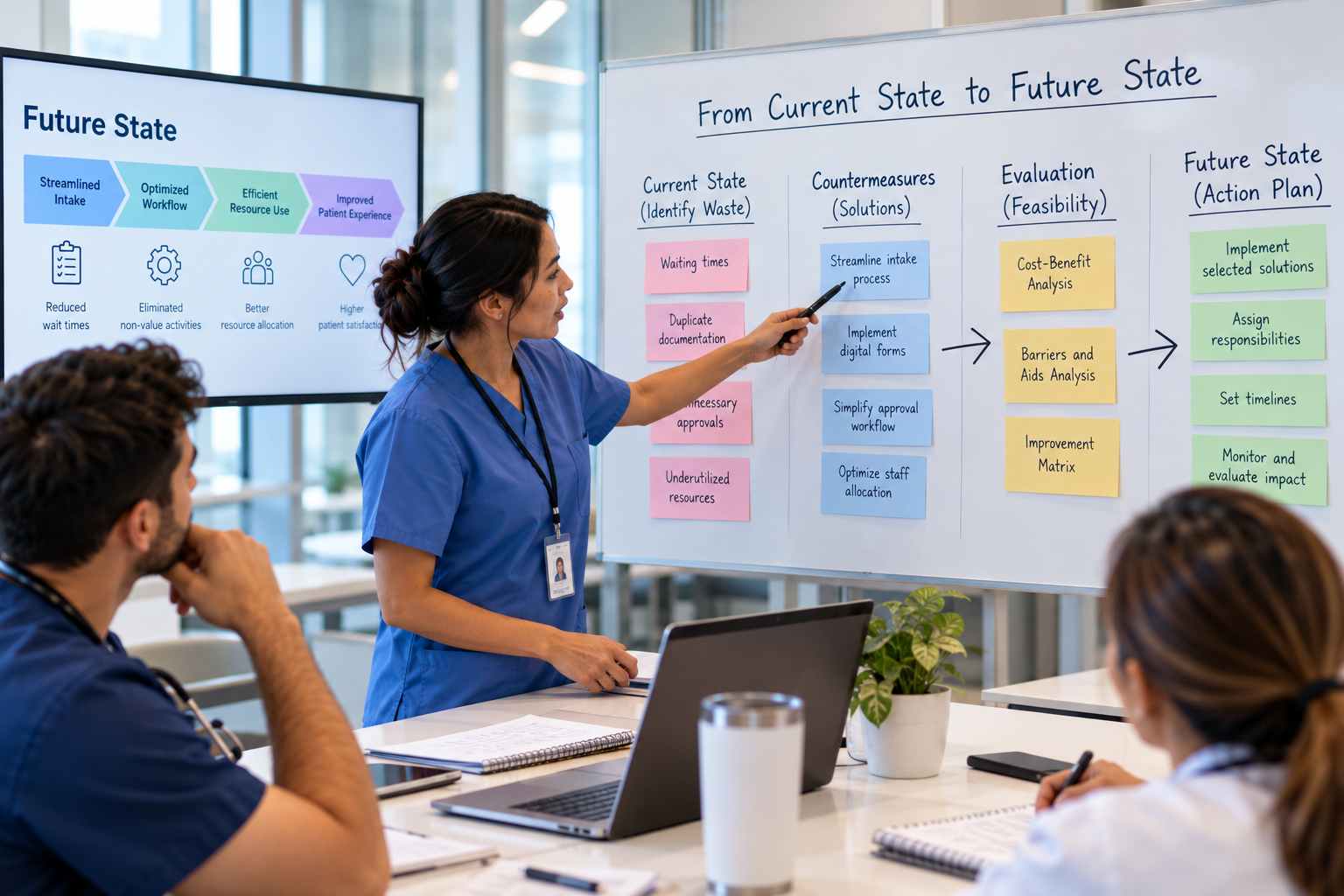
Improving healthcare processes requires identifying inefficiencies, evaluating opportunities for improvement, and developing practical solutions that support organizational excellence. Future state development provides a structured approach to reducing waste, optimizing workflows, and creating more effective healthcare processes.
In this course, learners will explore Lean Countermeasure Development methodologies to identify different types of waste and develop strategies to address them. Through practical healthcare scenarios, learners will assess potential improvements using cost-benefit analysis, barriers and aids analysis, and improvement matrices to determine their effectiveness and feasibility.
Learners will also develop an action plan outlining the steps required to implement selected countermeasures and support sustainable process improvements.
The time commitment for course completion is approximately 4 to 5 hours.
Who should attend?
This offering is designed for nurses and other healthcare professionals who want to develop practical skills in designing improved healthcare workflows, identifying opportunities for process improvement, and implementing effective quality improvement strategies.
This offering is ideal for:
- Nurses and healthcare professionals with little or no experience in process improvement or future state development.
- Healthcare staff transitioning into quality improvement, operational planning, or process improvement roles.
- Professionals involved in redesigning healthcare workflows to improve efficiency and patient care.
- Healthcare professionals interested in developing practical solutions to address operational challenges and inefficiencies.
- Individuals looking to strengthen their problem-solving, process redesign, and continuous improvement skills.
What you'll learn
Learners will develop the skills to identify inefficiencies in healthcare processes, evaluate potential solutions, and create actionable improvement plans using established Lean methodologies. By the end of the course, learners will be able to select appropriate countermeasures to address identified waste, assess their feasibility, and develop structured action plans to support implementation.
Course information
- Course structure
- Schedule
- Fees, discounts and registration
- Online delivery
- Policies
- Continuing Education Units
Self-directed and self-paced
This micro-credential course is self-directed and self-paced.
This micro-credential course will be delivered fully online with no scheduled lectures. Learners must complete the course independently, within the given timeframe.
Once registered, learners will be given a maximum of 10 weeks (70 days) to complete the course.
Marker-Grader support
This offering is supported by a marker-grader who provides feedback on assessments. Learners will have two attempts to successfully complete each assessment by the specified deadline, with feedback provided after their first attempt.
Self-paced
| Future State Development | Monday, January 11, 2027 to Monday, January 10, 2028 |
|---|
Self-paced
| Registration fee | Registration status |
|---|---|
| $149 CAD + HST |
|
Discounts
The Alumni/Staff Discount applies to registration in this program/course.
If you are alumni or staff, contact continuouslearning@ontariotechu.ca with your Student/Banner ID before registering for details about how to apply this discount.
Registration
You can register for this course through the secure online registration form. All course fees must be paid at the time of registration.
Online delivery
This offering may include, but is not limited to:
- Content presentations and/or videos;
- Case discussions;
- Individual work (assignments/quizzes);
- Concept and topic discussions;
- Topic reflections.
This is an open enrolment offering.
Those completing Ontario Tech University Continuous Learning open enrolment offerings (e.g. certificate programs, courses, workshops, microcertifications, etc.) are subject to the policies of Ontario Tech University and Continuous Learning. Ontario Tech policies can be found in the Policy library. Continuous Learning policies can be found in the Regulations section of the Continuous Learning website. Specifically, those completing open enrolment offerings are expected to adhere to the General and Open enrolment regulations.
Ontario Tech University – Continuous Learning assigns Continuing Education Units (CEUs) to eligible offerings. CEUs are awarded under the Ontario Tech University – Continuous Learning (CL) Framework for Awarding Continuing Education Units (CEUs) and Professional Development Hours Reference Standards.
CEUs are provided to support professional development reporting. They do not constitute accreditation or certification by an external licensing or regulatory body. Recognition and acceptance of CEUs are determined solely by the policies of individual employers, professional associations, or professional regulatory organizations.
Requirements
- Admissions
- Course completion
- Technology requirements
- Micro-credentials and digital badges
- OSAP for micro-credentials
To successfully complete the course, you must:
- Register and make full payment for the course.
- Successfully complete the course within 10 weeks (70 days) of your registration date.
Participants will receive a Level 1 micro-credential badge upon successful completion of the course.
Please note: Registration is available year-round. Once registered, learners have up to 10 weeks (70 days) to complete the course.
Technology requirements
Online learning requirements:
- Computer or device with internet access
- Stable internet or data connection
- Audio device (examples: speakers, headphones/earbuds, headset)
Material requirements
There are no additional materials required.
A micro-credential is a digitally-recorded recognition of a specific skill. It is a portable communication tool that represents evidence of your skills for employers, educators, and peers. Micro-credentials are created with industry, so you can be assured that the skills you are learning are in demand and current.
Learn more about micro-credentials and digital badges on the Learning Innovation website.
OSAP for Micro-credentials is available for eligible students taking a ministry-approved micro-credential that is less than 12 weeks. To be eligible for OSAP for Micro-credentials, a student must be a Canadian citizen, a permanent resident, or a protected person; and, be a resident of Ontario. A step-by-step guide on how to apply for OSAP for Micro-credentials is available here.
For more information please visit the OSAP website at www.ontario.ca/OSAP.