Data Fundamentals for Energy Professionals Micro-Credential Program
Overview
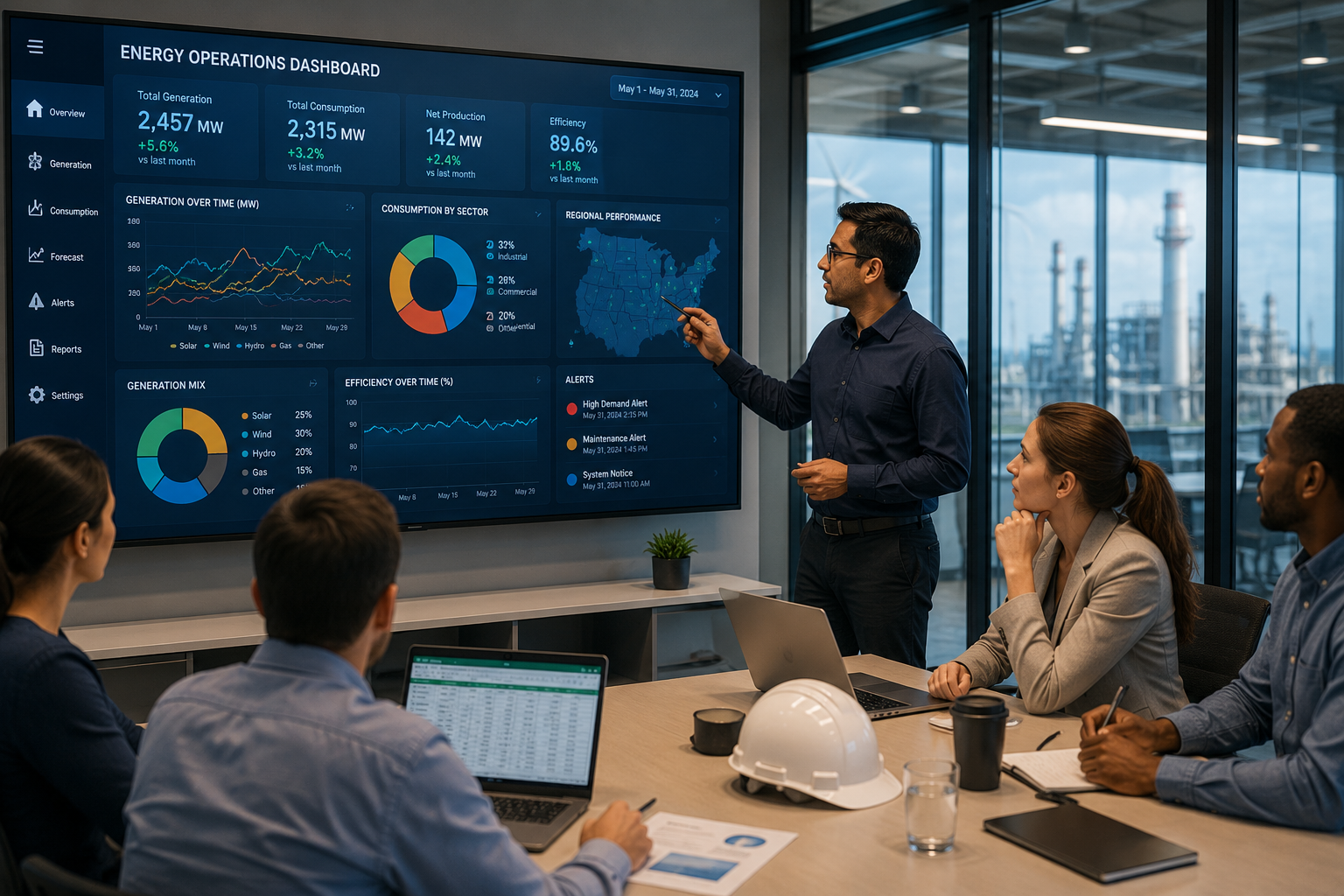
Data is increasingly important across the energy sector, helping professionals understand operations, identify trends, communicate insights, and support better decision-making. The Data Fundamentals for Energy Professionals Micro-Credential Program is designed to help energy professionals build practical data skills using commonly used tools such as Microsoft Excel, Power BI, and Python. Through applied, energy-focused scenarios, learners will develop foundational skills in data cleaning, descriptive and diagnostic analysis, visualization, dashboard creation, and insight generation. This program is ideal for professionals looking to strengthen their ability to work with energy production, consumption, efficiency, and operational data.
Learners who complete the program will be equipped to:
- Clean, organize, and prepare datasets for analysis
- Use Excel to identify trends, anomalies, and relationships in energy data
- Build clear visualizations and basic dashboards
- Use Power BI to analyze and compare data at different scales
- Apply basic Python processes to extract, transform, and analyze data
- Communicate data insights to support operational decision-making
Once registered, learners will be given a maximum of 10 weeks (70 days) to complete the course.
REGISTER NOW FOR THE FULL PROGRAMWho should attend?
This offering is designed for professionals in the energy sector or related fields who want to build foundational data analytics skills.
This offering is ideal for:
- Mid-career energy professionals
- Professionals working with production, consumption, efficiency, or operational data
- Staff moving into reporting, analytics, informatics, or data-informed roles
- Professionals who use Excel and want to expand into dashboards, Power BI, or Python
- Individuals looking to strengthen practical data skills without needing advanced analytics experience
What you'll learn
Across the program, learners will develop practical data analytics skills that can be immediately applied within energy organizations.
- Data preparation and analysis: Clean, organize, and validate energy datasets to improve data quality and support accurate analysis. Use descriptive and diagnostic analytics techniques to identify trends, anomalies, and performance issues within operational and consumption data.
- Data visualization and storytelling: Transform complex datasets into clear, actionable visualizations using Microsoft Excel. Learn how to select the most effective chart types, communicate insights to stakeholders, and create dashboards that support data-informed decision-making.
- Dashboard development with Power BI: Import, transform, and model data using Power Query and DAX. Design interactive dashboards that allow users to monitor key performance indicators, compare performance across sites, and uncover opportunities for improvement.
- Python for energy analytics: Apply basic ETL (Extract, Transform, Load) processes using Python to prepare and analyze energy datasets. Use Python tools to automate repetitive tasks, classify data, identify patterns, and generate meaningful insights.
- Data-driven decision making: Interpret analytical findings and translate them into recommendations that support operational efficiency, energy management, sustainability initiatives, and strategic planning.
- Industry-relevant application: Work through realistic energy-sector scenarios involving production, consumption, efficiency, and utility data to develop practical skills that can be applied immediately in the workplace.
Micro-credentials
-
Descriptive and Diagnostic Data Analytics in Energy with Excel
Professionals in the energy sector use Excel to organize and clean data related to production statistics and consumption data. It is also used to calculate average energy consumption or efficiency metrics for different buildings, equipment or time used in energy production among others. Oftentimes, descriptive and diagnostic analysis is the first type of intervention used to understand and resolve a problem. In this course, you will learn how to perform basic descriptive and diagnostic analysis using Microsoft Excel in order to identify anomalies. This includes conducting basic data cleaning, calculating central tendencies, creating basic visualizations, and performing correlation and regression analysis to resolve a data problem within an energy company.
The time commitment to complete this course is approximately 5 to 7 hours.
-
Data Visualization with Excel for Energy
The Energy industry analyzes large volumes of captured data in making operational decisions and often needs to visualize them to identify trends and obtain high level information on the health of key metrics. Microsoft Excel helps with the process of both preparing the data that goes into these visualizations and with creating the visualizations. In this course, you will develop strategies for visualizing various types of data using Microsoft Excel graph tools. You will clean data and create a variety of accurate visualizations in order to design a basic dashboard that allows for clear communication of data concepts.
The time commitment to complete this course is approximately 5 to 7 hours.
-
PowerBI for Data Energy Insights
In the energy sector, you can leverage PowerBI to analyze and visualize data related to energy production, consumption, and trends, enabling informed decision-making and strategic planning even without specialized data analysis skills. In this course, you will learn how to create basic visualizations in PowerBI in order to analyze and compare data points at various scales. You will start by using PowerQuery to import data into PowerBi, then manipulate Data Analysis Expressions (DAX) to create variables to identify the Energy Utility Index (EUI) according to a case study. Using this information you will proceed to create specific visualizations and organize them in a dashboard. Through this, you will be able to analyze and compare data points at different scales.
The time commitment to complete this course is approximately 5 to 7 hours.
-
Descriptive and Diagnostic Data Analytics in Energy with Python
In the energy sector, Python is used to automate the analysis of large datasets, making it easier to identify patterns and anomalies in energy consumption and production. Analysts can quickly calculate key metrics, such as energy efficiency and average consumption, to gain insights into system performance. Python also enables the development of predictive models that can forecast future energy needs and detect potential issues before they become significant problems, ultimately helping to optimize energy usage and reduce costs. In this course, you will perform basic ETL (Extract, Transform, Load) processes along with descriptive and diagnostic analysis using Python to extract relevant data points and derive meaningful insights. This will be conducted by identifying patterns and trends, and classifying data.
The time commitment to complete this course is approximately 5 to 7 hours.
Program information
Self-paced
| Descriptive and Diagnostic Data Analytics in Energy with Excel | Monday, September 14, 2026 to Monday, September 13, 2027 | |
|---|---|---|
| Data Visualization with Excel for Energy | Monday, September 14, 2026 to Monday, September 13, 2027 | |
| PowerBI for Data Energy Insights | Monday, September 14, 2026 to Monday, September 13, 2027 | |
| Descriptive & Diagnostic Data Analytics in Energy with Python | Monday, September 14, 2026 to Monday, September 13, 2027 |
Self-directed and self-paced
This Program is self-directed and self-paced. This micro-credential Program will be delivered fully online with no scheduled lectures. Learners must complete the course independently, within the given timeframe. Once registered, learners will be given a maximum of 10 weeks (70 days) to complete the Program.
Facilitator support
This offering is supported by a facilitator who is available to answer learner inquiries and provide feedback on assessments. Learners will have two chances to successfully complete each assessment by the specified deadline, after receiving feedback from the facilitator.
Self-paced
| Registration fee | Registration status |
|---|---|
| $499 CAD + HST (regular) |
|
| NOTE: Individual course fees and registration dates vary. View the relevant course page for more information. | |
Discounts
The Alumni/Staff Discount applies to registration in this program/course.
If you are alumni or staff, contact continuouslearning@ontariotechu.ca with your Student/Banner ID before registering for details about how to apply this discount.
Registration
You can register for this course through the secure online registration form. All course fees must be paid at the time of registration.
Online delivery
This offering may include, but is not limited to:
- Content presentations and/or videos;
- Case discussions;
- Individual work (assignments/quizzes);
- Concept and topic discussions;
- Topic reflections.
This is an open enrolment offering.
Those completing Ontario Tech University Continuous Learning open enrolment offerings (e.g. certificate programs, courses, workshops, microcertifications, etc.) are subject to the policies of Ontario Tech University and Continuous Learning. Ontario Tech policies can be found in the Policy library. Continuous Learning policies can be found in the Regulations section of the Continuous Learning website. Specifically, those completing open enrolment offerings are expected to adhere to the General and Open enrolment regulations.
Requirements
- Admissions
- Program completion
- Technology requirements
- Micro-credentials and digital badges
- OSAP for micro-credentials
To successfully complete the program, you must:
- Register and make full payment for the program;
- Successfully complete all four (4) micro-credential courses within 10 weeks (70 days) of registering for the program.
Participants will receive a Level 1 micro-credential badge upon successful completion of each individual micro-credential. Upon successful completion of all four (4) micro-credentials (the full program) participants will receive a Level 2 micro-credential badge.
Technology requirements
Online learning requirements:
- Computer or device with internet access
- Stable internet or data connection
- Audio device (examples: speakers, headphones/earbuds, headset)
Material requirements
There are no additional materials required.
A micro-credential is a digitally-recorded recognition of a specific skill. It is a portable communication tool that represents evidence of your skills for employers, educators, and peers. Micro-credentials are created with industry, so you can be assured that the skills you are learning are in demand and current.
Learn more about micro-credentials and digital badges on the Learning Innovation website.
OSAP for Micro-credentials is available for eligible students taking a ministry-approved micro-credential that is less than 12 weeks. To be eligible for OSAP for Micro-credentials, a student must be a Canadian citizen, a permanent resident, or a protected person; and, be a resident of Ontario. A step-by-step guide on how to apply for OSAP for Micro-credentials is available here.
For more information please visit the OSAP website at www.ontario.ca/OSAP.